
SwissImmigrationPro (SIP) explains the law; SIP represents no one and provides no individual legal advice. This role-based limitation follows from the Federal Act on the Freedom of Movement for Lawyers (BGFA/LLCA, SR 935.61), which reserves the practice of the legal profession to persons entered in the cantonal bar register. This deep-dive is a knowledge base, not a legal service.
1. Overview — the Canton of Jura in the immigration-law context
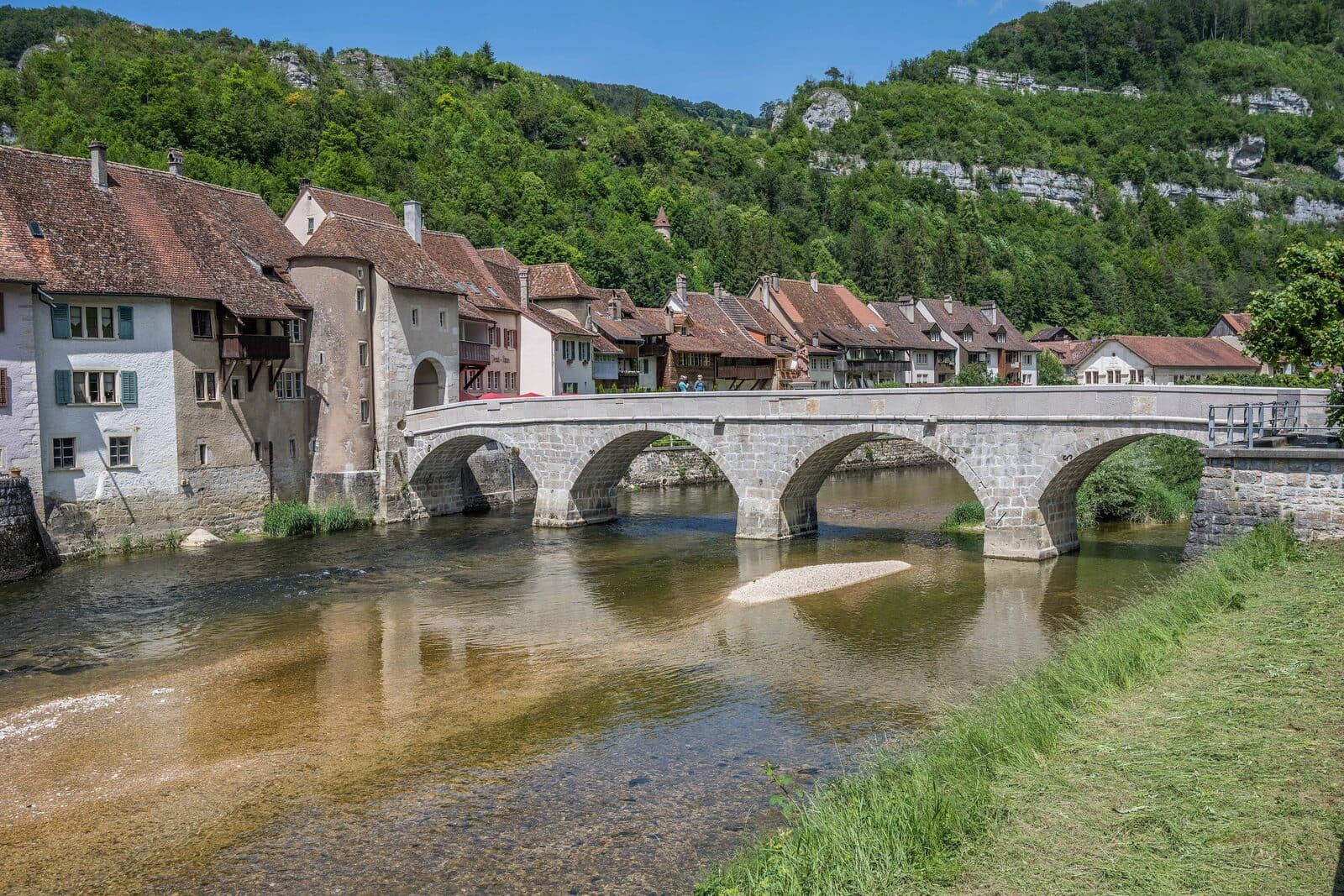
The Canton of Jura (German Jura, Italian Giura) is Switzerland's youngest canton (founded in 1979) and one of the smallest. Its capital is Delémont. It is predominantly rural and lies in the north-west along the French border; economically it is carried by microtechnology (supplying the watchmaking industry), agriculture and horse breeding. The resident population is in the order of around 73,000–75,000 people; the share of the resident population without Swiss citizenship is around one sixth. These orders of magnitude are descriptive; the respective current official figures are to be obtained from the Federal Statistical Office (FSO).
The competent cantonal migration authority is the Service de la population (SPOP) of the Republic and Canton of Jura, in Delémont. Owing to the canton's small size, it is a comparatively small administrative unit; the internal differentiation into sections is less pronounced than in larger cantons. The current organisational structure follows in each case from the cantonal portal.
Service de la population (SPOP), République et Canton du Jura, Delémont Address, counter opening hours and online portal: currently via the cantonal portal Web: https://www.jura.ch/DIN/SSP.html E-mail / telephone: via the contact details on the official authority page
Anti-Scope: this deep-dive is not a recommendation for or against the Canton of Jura as a canton of residence. Jurisdiction for residence-law proceedings strictly follows the civil-law domicile under Art. 23 CC (Swiss Civil Code, CC, SR 210). SIP gives no comparative assessment of the cantons.
2. Legal bases — federal law and cantonal implementing law
Residence law in the Canton of Jura rests — as in all cantons — on the same federal law. The following are in particular decisive:
- Federal Act on Foreign Nationals and Integration (FNIA, SR 142.20): admission to gainful employment (Art. 18 FNIA), entitlement to a permit in the context of family reunification and its limits (Art. 42–47 FNIA, Art. 50 FNIA), hardship case (Art. 30 para. 1 let. b FNIA), extension and expiry (Art. 33 FNIA), ordinary and early settlement (Art. 34 para. 2 FNIA, Art. 34 para. 4 FNIA), change of canton (Art. 37 FNIA), integration agreement and integration criteria (Art. 58a FNIA, Art. 58b FNIA), revocation of the permit for reasons of public security and order (Art. 62 FNIA, Art. 63 FNIA), the SEM approval procedure (Art. 99 FNIA), data processing and information (Art. 27 FNIA — conditions for admission for the purpose of education and continuing education).
- Ordinance on Admission, Period of Stay and Employment (OASA, SR 142.201): hardship criteria (Art. 31 OASA), proof of language skills and promotion of integration (Art. 60a OASA, Art. 77d OASA), cantonal jurisdiction and procedure (Art. 73 OASA), maximum numbers and quota management (Art. 85 OASA, Art. 86 OASA).
- Agreement on the Free Movement of Persons (AFMP, SR 0.142.112.681) between Switzerland and the EU as well as the parallel agreement with EFTA: right of residence of nationals of the EU/EFTA states; domestic implementation takes place through the Ordinance on the Introduction of the Free Movement of Persons (OFMP) (reference via Fedlex).
- Asylum Act (AsylA, SR 142.31): in particular allocation to the cantons (Art. 27 AsylA) and free legal representation in asylum proceedings (Art. 102f AsylA).
- Swiss Citizenship Act (SCA, SR 141.0) as the federal-law basis of ordinary naturalisation: formal conditions including the period of residence (Art. 9 SCA), substantive conditions (Art. 11 SCA) and integration criteria (Art. 12 SCA). The proof of language skills for naturalisation, by contrast, rests on the Citizenship Ordinance (OLN), in particular on its Art. 6 (SR 141.01) — the Act (SCA, SR 141.0) and the Ordinance (OLN, SR 141.01) are separate enactments and are not to be conflated.
- Victim Support Act (OHG, SR 312.5): victim support, in so far as it is relevant to immigration law.
The cantonal implementing law to the FNIA (the Jura introductory legislation on federal foreign-nationals law) governs the cantonal allocation of jurisdiction, the fees and the administrative procedure. The exact designation of the enactment and its reference are to be consulted via the cantonal compilation of laws (Recueil systématique jurassien, RSJU); SIP deliberately cites no cantonal enactment number here, since it cannot be reproduced reliably without official confirmation. Likewise applicable are the cantonal citizenship act and the cantonal administrative procedural law; their designation and reference are to be obtained via the cantonal compilation of laws.
Cross-link: for the systematic presentation of FNIA/OASA see the FNIA/OASA glossary of terms; for AFMP/OFMP see the AFMP/OFMP glossary; for asylum law see the glossary on the Asylum Act.
3. Competent authority — contact and accessibility
All residence-law proceedings (granting, extension, revocation, family reunification, change of status) lie in the Canton of Jura with the Service de la population (SPOP). The authority works in French; foreign-language documents must as a rule be submitted in a certified translation into French. The exact translation and certification requirements are to be ascertained on a case-by-case basis with the authority.
Service de la population (SPOP), République et Canton du Jura, Delémont Address, telephone and e-mail: currently via the official authority page Web: https://www.jura.ch/DIN/SSP.html Online portal: via https://www.jura.ch Counter opening hours and public-transport accessibility: via the official authority page
Owing to the canton's small size, the processing routes tend to be short and contact more personal; for more complex matters, less internal specialisation may lead to longer processing times. This classification is descriptive; consistently published, comparable statistics on processing times are not available.
4. Duration of proceedings — cantonal benchmark figures
The following benchmark figures are descriptive and provisional and do not replace any binding information from the authority. The processing time depends on the completeness of the documents, the type of permit and any approval by the SEM.
| Procedure | Benchmark (descriptive) | Note |
|---|---|---|
| B initial application (third country) | longer than the base benchmark | SEM approval under Art. 99 FNIA is added |
| B extension | shorter than the base benchmark | with complete documents |
| L short-term stay | close to the base benchmark | depending on the quota situation (Art. 85 OASA, Art. 86 OASA) |
| AFMP registration EU/EFTA | close to the base benchmark | declaratory permit |
| Base benchmark | order of magnitude of around four weeks | non-binding approximation; the SPOP's information is binding |
For approval-subject procedures, the duration is extended by the SEM approval procedure under Art. 99 FNIA — this federal stage is not included in the cantonal benchmark.
All figures are non-binding approximations; only the SPOP's information in the individual case is binding. SIP gives no assurance of processing times.
5. Proof of language skills
The language of proceedings and the decisive integration language in the Canton of Jura is French. Recognised standard proofs are as a rule DELF/DALF, the TCF (Test de connaissance du français) as well as the fide certificate in the French language; the cantonal recognition list within the framework of Art. 77d OASA is decisive. Which certificates the competent body currently recognises is to be checked via the cantonal body or the fide platform.
- Family reunification from third countries: on reunification, proof of basic oral skills at level A1 oral (or registration for a language-support offering) is as a rule required (Art. 43 FNIA, Art. 44 FNIA in conjunction with Art. 73a OASA and Art. 77 OASA). The specific cantonal configuration follows from the practice of the SPOP.
- Early C settlement under Art. 34 para. 4 FNIA in conjunction with Art. 60a OASA and Art. 77d OASA: oral skills at level B1 oral and written skills at level A2 written (B1o/A2w) are as a rule required. These thresholds apply as a standard requirement for both EU/EFTA and third-country nationals; early granting otherwise remains a discretionary decision of the authority within the overall integration assessment. The decisive language in the Canton of Jura is French.
- fide: the fide system serves the standardised proof of language competence for immigration-law purposes.
Anti-Scope: SIP gives no language-exam strategy advice (choice of exam format, preparation, repetition). The choice of exam route is an individual decision. The cantonal recognition list applicable at the time remains decisive.
6. Standard permit practice B / L / C
Permit practice in the Canton of Jura follows the federal-law standard under FNIA/OASA and the directives of the SEM (FNIA Directives / AFMP Directives). There is no cantonal special category deviating from federal law.
- B residence permit: for gainful employment (Art. 18 FNIA; for third-country nationals within the maximum numbers under Art. 85 OASA and Art. 86 OASA), family reunification (Art. 42–47 FNIA) or residence without gainful employment. EU/EFTA nationals receive the B permit on the basis of the AFMP; the permit has a declaratory effect to that extent.
- L short-term permit: for time-limited purposes (e.g. a fixed-term employment); for third-country nationals under quota management.
- C settlement permit: ordinarily as a rule after ten years (Art. 34 para. 2 FNIA; for nationals of certain states, on the basis of a settlement agreement, already after five years), early under Art. 34 para. 4 FNIA in the case of successful integration and fulfilled proof of language skills (B1o/A2w, see section 5) after five years.
Descriptive: the Jura migration authority processes a case volume that is limited in the inter-cantonal comparison; French-language integration offerings are available. This observation is purely descriptive, not a promise of practice and not an assessment of the prospects of success of an application.
Anti-Scope: SIP gives no individual permit strategy (application design, hardship-case argumentation under Art. 30 FNIA, family-reunification strategy) and no comparative assessment relative to other cantons. The legal appraisal of an individual case belongs to a lawyer entered in the canton.
7. Naturalisation
Ordinary naturalisation follows the three-tier procedure: Confederation (federal naturalisation authorisation of the SEM), canton and municipality. The federal-law basis is the Swiss Citizenship Act (SCA, SR 141.0); the proof of language skills is additionally governed by the Citizenship Ordinance (OLN, SR 141.01). The conditions are in particular the period of residence (Art. 9 SCA: as a rule ten years of residence in Switzerland, whereby the time spent between the completed 8th and the 18th year of age counts double, but at least six years; at the time of the application a valid C settlement permit is required), the substantive conditions (Art. 11 SCA) as well as the integration criteria (Art. 12 SCA). The B1 oral / A2 written proof of language skills rests on the Citizenship Ordinance (OLN), Art. 6 (SR 141.01). The cantonal and municipal period of residence is concretised by Art. 18 SCA (framework) as well as by the cantonal citizenship act and the municipal citizenship rules; their designation and the applicable residence periods are to be obtained via the cantonal compilation of laws.
Descriptive: as cantonal/municipal residence orders of magnitude, several years of cantonal residence and a few years of municipal residence are frequently cited; Art. 18 SCA sets the federal-law framework for this. The specifically applicable periods follow from cantonal and municipal citizenship law and are to be checked there; SIP deliberately cites no fixed number of years here, as these vary at the municipal level.
Anti-Scope: SIP gives no municipality-shopping recommendation and no strategy advice on the choice of the municipality of residence with a view to naturalisation practice. The choice of place of residence is not an immigration-law strategy.
8. Asylum in the canton
Asylum seekers are allocated to the cantons under Art. 27 AsylA via the SEM's distribution key; the first-instance asylum procedure is conducted in a Federal Asylum Centre (FAC) of the competent asylum region. The Canton of Jura is one of the French-speaking cantons and belongs to the asylum region competent for French-speaking Switzerland; the specific, currently valid FAC and asylum-region allocation is to be obtained via the SEM (sem.admin.ch).
In the asylum and removal procedure there is an entitlement to free advice and legal representation (Art. 102f AsylA); legal representation is provided by the legal advice office of the responsible umbrella organisation mandated by the SEM. Which umbrella organisation is currently mandated for the asylum region of the Canton of Jura is to be ascertained via the SEM (sem.admin.ch); SIP cites no fixed provider name here, as this mandate may change.
Cross-link: for the systematic presentation of the asylum procedure see the glossary on the Asylum Act.
9. Taxes and withholding tax — immigration-law context
Employees holding a B residence permit (as well as further persons without a C settlement permit) are subject, for their employment income, to withholding tax: the employer deducts the tax directly from the wage and remits it to the cantonal tax administration. Withholding taxation of employment income rests on the federal law of direct taxes and on tax-harmonisation law in conjunction with the cantonal withholding-tax tariff of the Canton of Jura; the cantonal tariff is decisive for the specific burden.
From a gross annual income of CHF 120,000, a subsequent ordinary assessment (SOA) takes place mandatorily: the person taxed at source is additionally assessed under the ordinary procedure, the withholding tax deducted being credited. Below this threshold, an SOA may be requested on application (in particular to claim additional deductions); EU/EFTA nationals can demand equal treatment via the AFMP. The exact conditions, deadlines and tariffs are to be ascertained from the cantonal tax administration of the Canton of Jura.
Descriptive: as in every canton, the effective tax burden results from the interplay of cantonal, municipal and federal tax and varies depending on the municipality of residence. SIP makes no comparative or evaluative statement on this; a specific burden can only be determined on the basis of the individual circumstances and the official tariffs.
Anti-Scope: SIP makes no tax advice available. Questions on withholding tax, on the SOA, on social deductions as well as on inter-cantonal or international double-taxation matters belong to qualified tax advisers or to the cantonal tax administration.
Note on the relationship between debts and status: tax debts or a debt-enforcement action do not directly lead to the revocation of a permit. Art. 62 FNIA and Art. 63 FNIA concern revocation for reasons of public security and order as well as in the case of serious breaches; a strained financial situation may at most affect status indirectly, in so far as it feeds into the integration assessment (Art. 58a FNIA). An individual appraisal belongs to a lawyer entered in the canton.
10. Economy and largest municipalities
Descriptive: the Canton of Jura is Switzerland's youngest canton (founded in 1979), French-speaking and located in the north-west along the French border. Economically defining are microtechnology (supplying the watchmaking industry), agriculture and horse breeding. French-language integration offerings exist. Statements on the cost of living, rent levels or the share of the foreign resident population differ depending on the municipality and the time of survey; reliable, comparable figures are to be obtained from the Federal Statistical Office (FSO) and via the cantonal or municipal sources. SIP gives no comparative or evaluative classification relative to other cantons.
Largest municipalities (descriptive): Delémont (capital), Porrentruy, Saignelégier, Courrendlin.
These geographic and economic particularities have an indirect effect on typical permit constellations (microtechnology, agriculture, cross-border-commuter constellations with France), but they are not a legal statement and not an argument for the choice of a canton of residence.
11. Anti-scope declaration for the Canton of Jura
The practice of the legal profession is governed in the Federal Act on the Freedom of Movement for Lawyers (BGFA/LLCA, SR 935.61); the actual legal representation and individual legal advice remain reserved to persons entered in the cantonal bar register. On account of this division of roles between knowledge platform and lawyer service, and in order to preserve credibility vis-à-vis the cantonal supervisory authorities, SIP expressly keeps the following topics outside the scope of its services:
- No canton-shopping strategy: no recommendation as to in which canton a procedure could be conducted "more advantageously". Jurisdiction follows the civil-law domicile under Art. 23 CC (CC, SR 210).
- No comparative leniency assessment: no statement that the Canton of Jura is "easier" or "stricter" than another canton.
- No individual case strategy: no hardship-case argumentation (Art. 30 FNIA), no family-reunification strategy, no appeal or deadline strategy, no appeal templates or deadline calculators.
- No tax advice and no tax optimisation.
- No individual lawyer recommendation outside the structured SIP referral.
For individual questions, a BfR-registered lawyer entered in the canton should be consulted. SIP explains the law and represents no one.
12. Cross-References
- FNIA/OASA glossary of terms — FNIA/OASA systematics.
- AFMP/OFMP glossary — AFMP/OFMP systematics.
- Glossary on the Asylum Act — asylum-law systematics.
- Romandie standard cluster (VD/FR/NE/JU) — higher-level Romandie standard overview.
- B residence permit, C settlement permit, L short-term permit — permit types.
- Change of canton (Art. 37 FNIA) — change of canton under Art. 37 FNIA.
- Proof of language skills — language exams and recognised diplomas.
- Hardship-case rule (Art. 30 FNIA) — hardship case under Art. 30 para. 1 let. b FNIA.