
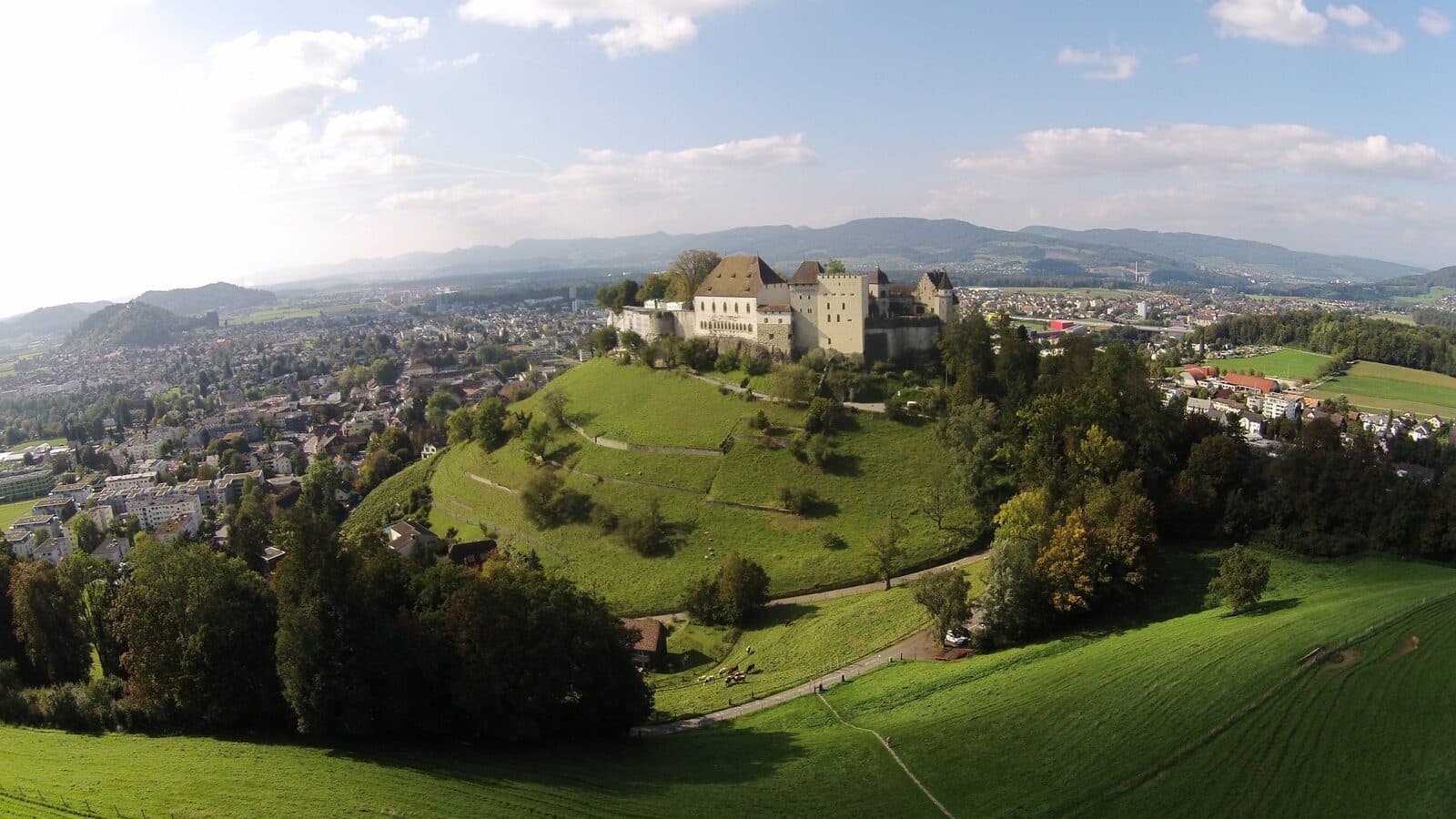
1. Overview — the Canton of Aargau in the context of migration law
The Canton of Aargau is among the most populous cantons of German-speaking Switzerland; its capital is Aarau, and the primary procedural language in migration proceedings is German. The share of the foreign resident population is in the range of roughly one quarter of the total population. The specific population, area and proportion figures are deliberately not printed here as fixed values, but are to be obtained from the Federal Statistical Office (FSO) and the cantonal statistical office of the Canton of Aargau, since they are updated annually.
Aargau lies centrally between the economic regions of Zurich, Basel and Bern. This locational characterisation — an industrial and technology hub with a broad services and industrial base — is purely descriptive and constitutes no recommendation as to the choice of canton of residence (cf. sections 10 and 11).
The competent cantonal authority for all residence-law proceedings is the Amt für Migration und Integration Kanton Aargau (MIKA).
Amt für Migration und Integration Kanton Aargau (MIKA) Online portal: https://www.ag.ch/mika Address, telephone, e-mail, counter opening hours and public-transport access: to be obtained currently from the official authority website ag.ch/mika. The postal address and contact channels are not printed here as fixed values, because authority addresses and direct lines can change; the official site is the governing source.
1.1 Aargau's migrant population in figures
Aargau's migration structure can be characterised qualitatively as follows; exact permit statistics are to be obtained from the FSO or the cantonal statistical office:
- EU/EFTA nationals and third-country nationals together form the foreign resident population, which amounts to roughly one quarter of the population.
- B permits (residence permit), C permits (settlement permit) and L permits (short-term permit) constitute the ordinary permit categories.
- G permits (cross-border commuters) occur, owing to the inland location, to a lesser extent than in cantons near the border.
- F, N and S permits concern asylum-law constellations within the framework of the distribution key of the State Secretariat for Migration (Art. 27 AsylA; Asylum Act, AsylA, SR 142.31).
2. Legal bases — federal law and cantonal implementing law
2.1 Applicable federal law
In migration law, the Canton of Aargau — like all cantons — applies federal law as a matter of priority: the Federal Act on Foreign Nationals and Integration (FNIA, SR 142.20), the Ordinance on Admission, Residence and Gainful Employment (OASA, SR 142.201), the Agreement on the Free Movement of Persons (AFMP, SR 0.142.112.681) together with the associated ordinance on the introduction of the free movement of persons (OFMP), the Asylum Act (AsylA, SR 142.31) as well as the relevant practice and directives of the State Secretariat for Migration (SEM). Central provisions are in particular admission to gainful employment (Art. 18 FNIA), admission to education and further training (Art. 27 FNIA), the hardship case (Art. 30 para. 1 let. b FNIA), the ordinary settlement permit (Art. 34 para. 2 FNIA) and the early settlement permit (Art. 34 para. 4 FNIA), the change of canton (Art. 37 FNIA), family reunification (Art. 42–47 FNIA), the dissolution of the family unit (Art. 50 FNIA), the integration criteria and integration agreement (Art. 58a FNIA and Art. 58b FNIA), revocation (Art. 62 FNIA and Art. 63 FNIA) as well as the Confederation's approval requirement (Art. 99 FNIA). For an in-depth presentation of the federal-law bases see the FNIA and OASA glossary of terms, the AFMP/OFMP glossary and the glossary of the Asylum Act.
2.2 Cantonal implementing law
At cantonal level, the following are particularly relevant:
- the cantonal implementing law to the FNIA (Aargau introductory or implementing provisions to the Federal Act on Foreign Nationals and Integration). The formal designation and the cantonal enactment numbering may change and are to be obtained from the cantonal collection of laws (Systematic Collection of the Law of the Canton of Aargau).
- the cantonal citizenship act of the Canton of Aargau: cantonal concretisation of the citizenship procedure in addition to the federal Swiss Citizenship Act (SCA, SR 141.0) and the Swiss Citizenship Ordinance (OSC, SR 141.01) — see section 7. The cantonal enactment number is to be obtained from the cantonal collection of laws.
- the cantonal administrative-justice law: cantonal procedural law for proceedings before the cantonal administrative authorities and the cantonal administrative jurisdiction.
The relevant cantonal enactments with a migration nexus are accessible via the cantonal collection of laws of the Canton of Aargau. Specific cantonal enactment numbers are deliberately not stated here, because they may change and are to be obtained in a binding manner from the cantonal collection of laws.
3. Competent authority — contact and accessibility
The competent authority for all foreign-nationals-law proceedings is the Amt für Migration und Integration Kanton Aargau (MIKA). The binding and always up-to-date point of contact is the online portal:
- Online portal / web: https://www.ag.ch/mika
The postal address, telephone number, e-mail address, counter opening hours, telephone exchange and public-transport access of the office are to be obtained from ag.ch/mika and are not printed here as fixed individual values, in order to avoid an outdated particular on a legal-information page.
Via the online portal ag.ch/mika, it is generally possible to obtain forms and to initiate certain procedural steps digitally. The exact scope of the procedures available online — in particular extensions, address changes, appointment reservation and initial applications — as well as specialised contact e-mails of individual departments and the regional branch-office structure of the office are to be obtained from the portal.
4. Processing time — cantonal reference values
The typical processing times at the MIKA are presented here as reference values; they are not official processing commitments (SLA) and may vary considerably depending on the state of the file, the completeness of the documents, the workload of the respective section and the complexity of the case. As a rough guidance value for uncomplicated standard procedures, a processing time of around six weeks is cited; initial applications tend to take longer, extensions tend to be shorter. The table below is to be read relative to this guidance value.
| Procedure | Reference duration (relative) |
|---|---|
| B initial application (family reunification, gainful-employment application) | longer than the ~6-week guidance value |
| B extension | shorter than the ~6-week guidance value |
| C application ordinary (Art. 34 para. 2 FNIA, after 10 years) | in the range of the ~6-week guidance value |
| C application early (Art. 34 para. 4 FNIA, after 5 years) | in the range of the ~6-week guidance value |
| Family reunification (third country, Art. 42–47 FNIA) | longer than the guidance value |
The currently valid official reference values are to be obtained from ag.ch/mika.
Note: the SEM approval of cantonal preliminary decisions under Art. 99 FNIA (in conjunction with Art. 85 OASA and Art. 86 OASA) is not included in the reference values mentioned above and may, in constellations subject to approval, require additional weeks to months.
5. Proof of language proficiency
The governing language in the Canton of Aargau is German; for the proof of language proficiency the High German variant is decisive, Swiss German is not exam-relevant.
- Family reunification from a third country: for the grant of a B permit in family reunification from a third country, proof of German at level A1 oral under the Common European Framework of Reference for Languages (CEFR) is generally required (Art. 43 FNIA in conjunction with Art. 73 OASA).
- Early C settlement permit (Art. 34 para. 4 FNIA in conjunction with Art. 60a OASA and Art. 77d OASA): for the early grant after five years instead of ten, a level of B1 oral and A2 written in German is required. These heightened requirements apply as a federal-law minimum standard; their application in the individual case remains a matter of the authority's assessment.
The fide certificate in the German language is accepted as an officially recognised proof. In addition, the diplomas and certificates named in Art. 77d OASA are valid, in particular telc, Goethe and ÖSD certificates at the corresponding level. The exact requirements of Aargau's application practice are to be clarified with the MIKA, since cantonal interpretations of the federal-law minimum language standards may diverge in individual points. For an in-depth presentation see the proof of language proficiency (A1 / A2 / B1 fide).
6. Standard permit practice B / L / C
When granting permits, the Canton of Aargau applies the federal standard under the FNIA/OASA and the SEM directives.
- B (residence permit): grant in the case of gainful employment (Art. 18 FNIA for third-country nationals; AFMP/OFMP for EU/EFTA nationals), in the case of education and further training (Art. 27 FNIA) as well as in family reunification (Art. 42–44 FNIA). The cumulative requirements (earned income, suitable accommodation, no dependence on social assistance, language, integration) are examined according to the federal-law standard.
- L (short-term permit): time-limited permit, frequent in the case of temporally limited gainful activities; the subcategories follow the OASA. For an in-depth presentation see the L short-term permit and its subclasses.
- C (settlement permit): ordinary grant after ten years (Art. 34 para. 2 FNIA); early grant after five years in the case of successful integration (Art. 34 para. 4 FNIA in conjunction with Art. 60a OASA and Art. 77d OASA), which lies within the discretion of the cantonal authority and presupposes heightened language skills (B1 oral, A2 written), economic self-sufficiency without receipt of social assistance as well as an impeccable reputation.
As the migration office of a heavily populated canton, the MIKA handles a correspondingly large case volume. No statement can be derived from this about the prospects of success of a specific application; the assessment is always made on a case-by-case basis according to the statutory requirements.
Anti-scope: SwissImmigrationPro provides no strategic advice regarding the grant of permits in the individual case — neither as to the argumentation of a gainful-employment or family-reunification application nor as to the early grant of the C permit. The case-specific assessment belongs to the practice of lawyers or to advice from the competent authority.
7. Naturalisation
Naturalisation in Switzerland follows a three-tier procedure: federal (federal naturalisation authorisation under the Swiss Citizenship Act and the Swiss Citizenship Ordinance), cantonal (citizenship of the Canton of Aargau under the cantonal citizenship act) and communal (citizenship of the municipality of residence). All three levels must be met cumulatively.
7.1 Federal-law requirements
At the federal level, the requirements of the Swiss Citizenship Act (SCA, SR 141.0) (in force since 1.1.2018) and the Swiss Citizenship Ordinance (OSC, SR 141.01) apply:
- a period of residence of ten years in Switzerland as well as possession of a settlement permit (Art. 9 SCA);
- successful integration and observance of public security and order as integration criteria (Art. 11 SCA and Art. 12 SCA);
- a proof of language proficiency of B1 oral and A2 written in a national language — the language requirement is regulated in the Swiss Citizenship Ordinance (Art. 6 (SR 141.01) of the Swiss Citizenship Ordinance [OSC/OLN]); in the Canton of Aargau the governing national language is German.
The residence and integration criteria (Art. 9 SCA, Art. 11 SCA and Art. 12 SCA) are in the Swiss Citizenship Act (SCA, SR 141.0), while the language requirement is regulated in the Swiss Citizenship Ordinance (OSC, SR 141.01) (Art. 6 (SR 141.01) of the Swiss Citizenship Ordinance); these are two separate enactments, which are not merged here. For an in-depth legal presentation see the glossary of the Swiss Citizenship Act 2018.
7.2 Cantonal and communal requirements
At the cantonal and communal level, the Aargau citizenship procedure requires a residence of several years in the canton as well as in the municipality of residence. Orders of magnitude of a few years of cantonal and a few years of communal residence are frequently cited; the exact minimum periods are regulated in the cantonal citizenship act and in the respective communal regulation and vary between municipalities. The binding values are to be obtained from the cantonal collection of laws and from the municipality of residence.
Anti-scope: SwissImmigrationPro gives no recommendation as to in which Aargau municipality a citizenship application would be "easier". Any such municipality-shopping advice is excluded; the citizenship procedure is governed by the place of residence and not by tactical considerations.
8. Asylum in the canton
Aargau is integrated into the national asylum architecture. The first phase of the accelerated asylum procedure (Art. 26b AsylA; Asylum Act, AsylA, SR 142.31) takes place in the federal asylum centres (FAC) of the respective asylum region; the assignment of the Canton of Aargau to a particular FAC asylum region is to be obtained from sem.admin.ch. Where an application is transferred into the extended procedure (Art. 26d AsylA), the assignment to the cantons takes place according to the SEM's distribution key (Art. 27 AsylA); Aargau takes in a share corresponding to its population size.
The legal advisory service for asylum seekers active in the canton is run by an organisation mandated or recognised by the SEM (Art. 102f AsylA). The specific organisation for the asylum region of the Canton of Aargau is to be obtained from sem.admin.ch or from the Swiss Refugee Council (osar.ch); it is presented here generically and without naming, in order to avoid an outdated particular.
For an in-depth presentation of asylum law see the glossary of the Asylum Act.
9. Taxes and withholding tax — migration-law context
Both third-country B-permit holders and EU/EFTA B-permit holders without a settlement permit are generally subject to withholding tax (taxation of earned income at source). The withholding taxation of earned income is a tax harmonised under federal law but levied cantonally in its execution; the tax deduction is made by the employer and remitted to the cantonal tax administration. Where the annual gross earned income exceeds the threshold of CHF 120'000, a subsequent ordinary assessment (SOA) is carried out ex officio. For lower incomes, the withholding tax generally has a discharging effect; a subsequent ordinary assessment may, however, be carried out upon request. With the grant of the C settlement permit or with marriage to a Swiss citizen, the withholding-tax liability ceases and the ordinary tax assessment applies.
The tax burden of the Canton of Aargau is deliberately not qualified or classified here. An assessment as "low", "high" or "advantageous" would be neither demonstrable nor admissible and would constitute no reason to choose Aargau for tax reasons. The effective tax burden depends on the municipality, income and personal situation and is to be enquired about with the cantonal tax administration.
Anti-scope: SwissImmigrationPro is not tax advice. For questions on withholding tax, the subsequent ordinary assessment, tax status or double-taxation matters, the cantonal tax administration or a qualified tax adviser is to be consulted.
10. Economy and largest municipalities
The particulars below are purely descriptive and serve for orientation, not for the choice of location.
- Location and economy: Aargau lies centrally between Zurich, Basel and Bern and is regarded as an industrial and technology hub with a broad services and industrial base. The central location and proximity to several employment centres shape the canton's migration profile.
- Housing costs: rent levels vary strongly by municipality, location and property; reliable current rent-price benchmarks are to be obtained from the cantonal statistical office or the FSO and common rent-price surveys. A single reference value is not printed here, because it would be misleading without a current source.
- Larger municipalities: among the more populous municipalities are usually Aarau (capital), Baden, Wettingen, Brugg and Wohlen. The current ranking is to be obtained from the cantonal statistical office.
11. Anti-scope statement for the Canton of Aargau
In the present content, SwissImmigrationPro makes available cantonal practice information that facilitates orientation in Aargau migration law. Expressly not covered are:
- strategic advice in the individual case (hardship-case argumentation under Art. 30 para. 1 let. b FNIA, permit strategy, family-reunification strategy, appeal strategy).
- appeal or deadline aids — no appeal-brief templates, no appeal strategy, no deadline-calculating tools.
- comparative leniency judgments — no statement that Aargau is "easier" or "stricter" than another canton.
- anti-canton-shopping pointers — no recommendation to apply in another canton because the practice there would appear more favourable; no recommendation as to the choice of canton of residence or municipality of naturalisation.
- tax advice — in particular no optimisation of the withholding-tax position or of the subsequent ordinary assessment.
An outstanding debt or an ongoing debt-enforcement does not by itself lead to the revocation of a permit. The grounds for revocation and lapse under Art. 62 FNIA and Art. 63 FNIA attach to security and order facts; indebtedness can affect the foreign-nationals-law status at most indirectly, via the integration assessment (Art. 58a FNIA). For debt-enforcement-law questions, the Federal Act on Debt Enforcement and Bankruptcy (DEBA, SR 281.1) applies; SwissImmigrationPro operates no debt-enforcement monitor and gives no corresponding advice.
Anyone who needs a case-specific legal assessment turns to a lawyer entered in the cantonal bar register, to a legal advisory service for asylum seekers (asylum constellation) or to the competent cantonal or communal authority. In constellations of domestic violence or victim protection, the Victim Support Act (VSA, SR 312.5) applies; the cantonal victim-support office is the first point of contact. The authorities and advisory services listed in the present content are first orientation points and not a recommendation in the legal-advisory sense.
12. Cross-References
- FNIA and OASA — glossary of terms — federal-law framework provisions (FNIA, OASA)
- Agreement on the Free Movement of Persons (AFMP) and free movement of persons Switzerland–EU/EFTA — Agreement on the Free Movement of Persons EU/EFTA (AFMP/OFMP)
- Glossary of the Asylum Act — asylum law (AsylA)
- Glossary of the Swiss Citizenship Act 2018 — Swiss Citizenship Act and Ordinance (SCA/OSC)
- Cluster — German-language standard-practice cantons — sibling overview of the German-language standard cluster
- The B residence permit — B permit in general
- C settlement permit — C permit in general
- The L short-term permit — L permit
- G permit (cross-border commuter permit) — G permit (cross-border commuters)
- Ci permit — Ci permit
- N residence permit during the asylum procedure — N permit
- Provisional admission (F permit) — F permit
- Protection status S — S permit
- Naturalisation in Switzerland — paths to citizenship — naturalisation paths
- Proof of language proficiency (A1 / A2 / B1 fide) — proof of language proficiency
- Family reunification by a Swiss national — family reunification
- Hardship-case rule under Art. 30 FNIA — hardship case Art. 30 FNIA
- Change of canton and residence permit (Art. 37 FNIA) — change of canton Art. 37 FNIA
- Divorce and residence permit (Art. 50 FNIA) — dissolution of the family unit Art. 50 FNIA